MSP Revenue Architecture: The System MSP Owners Use to Control Growth
Why most MSPs suffer from a success mirage and how to move from unpredictable growth to a predictable, owner-controlled revenue engine.
Many MSPs look successful on the surface. Revenue is growing, the team is busy, and the client list looks impressive. Yet behind the scenes, the business feels fragile. The pipeline appears late, deals stall, and pricing gets negotiated down. The problem is not a lack of leads. The problem is a lack of revenue control.
This is not a sales problem or a marketing problem. It is a systems problem. This guide introduces a new framework for MSP growth called Revenue Architecture. It is the system that allows you to move from unpredictable, referral-driven revenue to a predictable, owner-controlled growth engine. We will deconstruct the components of this system, show you how they fit together, and provide a clear path to installing it in your own MSP.
Key Takeaways: Your Executive Summary
- The Core Problem is Systemic, Not Tactical. Most MSPs suffer from a “success mirage” where surface-level growth hides a fragile, unpredictable revenue model. The root cause is not a lack of marketing effort but the absence of a coherent revenue system.
- MSPs Have Architectures for Everything Except Revenue. MSPs meticulously design their service architecture, security architecture, and technology stacks, yet leave their most critical function, revenue generation, to chance, referrals, and random acts of marketing.
- Revenue Architecture Creates Predictability. It is the integrated system that governs who enters your pipeline, why they engage, how they move toward a decision, and when revenue becomes predictable. It is about installing control, not just increasing activity.
- The System Has Seven Core Components. A complete MSP Revenue Architecture consists of a Market Frame, Messaging System, Entry Points, Qualification Engine, Sales Motion, Revenue Cadence, and a Control Loop. These components work together to create a self-correcting growth engine.
- Tactics Fail Without a System. SEO, paid ads, and outsourced SDRs are merely tools. When deployed within a broken or non-existent revenue system, they consistently fail to produce a positive ROI because the underlying structure to convert interest into revenue is missing.
- The Goal is Control Over Timing and Quality. The ultimate outcome of a well-designed Revenue Architecture is not just more leads, but control over the timing and quality of deals entering the pipeline, leading to shorter sales cycles, higher pricing power, and reduced owner dependence.
Section 1: The Hidden Problem in the MSP Industry
The managed services industry is filled with what can be called a success mirage. From the outside, many MSPs appear to be thriving. They post healthy year-over-year revenue growth, their technicians are fully utilized, and their client logos are respectable. However, for the owner, the feeling is one of constant, low-grade anxiety. The business feels perpetually one lost client or one dry quarter away from a crisis.
This fragility stems from a series of symptoms that are often mistaken for the normal course of business:
- Referrals drive the vast majority of revenue. While referrals are valuable, an over-reliance on them means your growth is controlled by your clients and your network, not by you.
- The pipeline arrives randomly. New opportunities appear in unpredictable bursts, creating a feast-or-famine cycle that makes strategic planning nearly impossible.
- Deals stall late in the process. Prospects who seemed like a perfect fit go dark for weeks or months, only to resurface with a lowball offer or a decision to do nothing.
- The owner must handle all key sales conversations. The business cannot close significant new MRR without the direct involvement of the founder, creating a permanent bottleneck to growth.
- Marketing activity does not translate into predictable deals. The MSP invests in a new website, SEO, or social media, but the activities feel disconnected from the sales pipeline. There is no clear line from effort to revenue.
These are not individual problems to be solved with tactical fixes. They are the collective output of a single, deeper issue. What most MSPs lack is not marketing effort. They lack a revenue system.
Section 2: Why MSP Growth Feels Random
Every mature MSP operates on a set of well-defined architectures. These systems are what allow the business to deliver reliable, scalable, and profitable services. Without them, the operation would collapse into chaos.
Consider the architectures already present in your business:
- Service Architecture: You have a structured system for onboarding new clients, managing tickets, deploying solutions, and conducting QBRs. It is documented and repeatable.
- Security Architecture: You have a set of standards for protecting client environments, managing patches, and responding to threats. It is proactive and systematic.
- Technology Architecture: You have selected a stack—PSA, RMM, documentation tools—that allows your team to work efficiently.
Yet, when it comes to the lifeblood of the business—the revenue engine—most MSPs have no architecture at all. They rely on “hope” as a primary strategy. They hope the phone rings. They hope a client provides a referral. They hope their latest marketing initiative finally works.
Revenue Architecture is the missing system. It is the bridge between your technical expertise and a predictable, scaling business.
Section 3: The Framework of Revenue Architecture
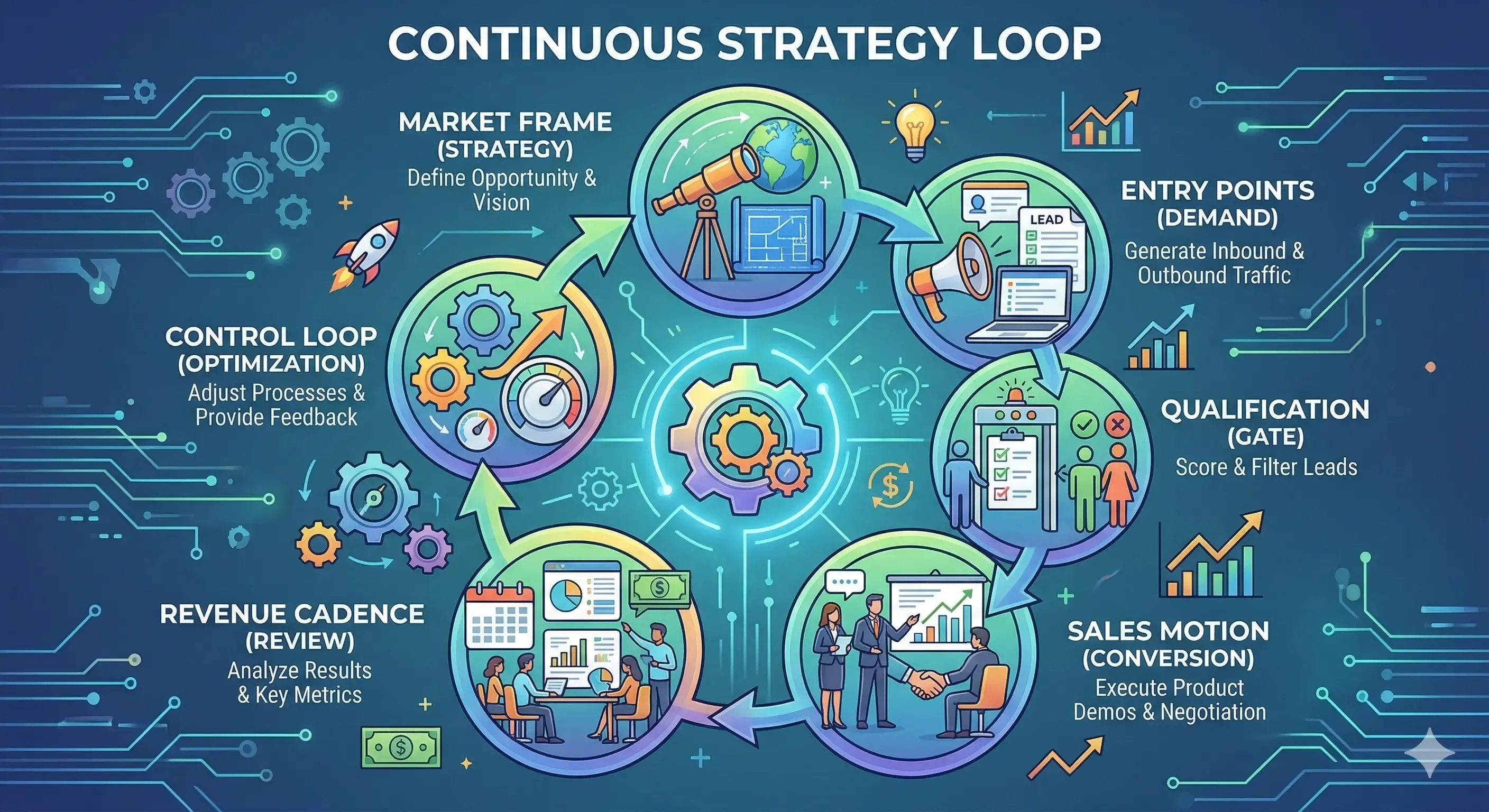
The Revenue Architecture model is built on seven integrated components. When these components are aligned, they create a flow that moves a prospect from unaware to a profitable, long-term client with minimal friction.
1. The Market Frame
This is the defined lens through which the market sees you. It is not just about “what you do,” but “who you are for” and “why you win.” A strong market frame allows you to command higher pricing by positioning you as a specialist rather than a commodity vendor.
2. The Messaging System
Your messaging must move beyond technical jargon and focus on the business outcomes your clients care about. It must speak to the “pains” of the owner and the “gains” of the solution.
3. Entry Points
These are the specific, low-friction ways a prospect first engages with your firm. A generic “Contact Us” form is a weak entry point. A high-value diagnostic or a strategic briefing is a strong entry point.
Section 4: Implementing the System
Installing a Revenue Architecture is not an overnight process. It requires a fundamental shift in how the MSP owner views their role.
The goal is to move from being the Chief Sales Officer—the person who has to close every deal—to the Chief Architect—the person who designs and monitors the system that closes the deals.
Common attempts include:
- SEO Agencies: They hire a firm to improve their Google rankings, hoping to attract more inbound traffic.
- Paid Ads: They invest in Google Ads or LinkedIn Ads to drive clicks to their website.
- Outsourced SDR Teams: They contract with a service to make cold calls or send cold emails on their behalf.
- Marketing Automation: They purchase a platform like HubSpot or SharpSpring to nurture leads with email campaigns.
While none of these tactics are inherently bad, they almost always fail to deliver a sustainable ROI for one simple reason: these tools operate inside a system. If the underlying revenue system is broken, the tools will fail. An effective tool cannot fix a broken system.
Section 5: The MSP Revenue Diagnostic
The first step in designing a Revenue Architecture is to understand the current state of your existing, informal system. This is the purpose of the MSP Revenue Diagnostic, a structured analysis that serves as the primary entry offer for engaging with this methodology.
The outcome of the diagnostic is not a proposal for marketing services. The outcome is clarity. You receive a detailed report that shows you exactly where your current system leaks revenue, time, and profit.
Section 6: Next Steps
If you are an MSP owner looking to take control of your growth, there are three paths forward:
- Take the Revenue Diagnostic: The most direct path to systemic clarity.
- Review the Frameworks: Explore the blog archive to understand the individual pillars of the model.
- Schedule a Call: Discuss how these principles apply to your specific situation.
Building a predictable revenue model?
I help technology leaders design scalable sales systems and turn communications platforms into profitable recurring services.
Work With Greg
Greg Steinig
Telecom & MSP Revenue Strategist
Greg Steinig is Vice President of Sales at SPARK Services and a longtime leader in the telecommunications and managed services industries. He previously served as Vice President of Sales at 3CX, where he helped scale annual recurring revenue from $20 million to $167 million. Greg writes and advises on VoIP strategy, MSP growth, and revenue systems for technology companies.
Learn more about Greg →.CTL8kw-5_10saEn.webp)