
VoIP Strategy: How Smart Businesses Design Their Phone Systems
A comprehensive guide on designing a strategic VoIP infrastructure that balances reliability, security, and cost-effectiveness for modern businesses.
VoIP Strategy: How Smart Businesses Design Their Phone Systems
Most companies treat their phone system like office plumbing. It works or it doesn’t. When it breaks, they replace it. That mindset misses the real opportunity. VoIP is not just a phone system. It is a communications platform that affects customer experience, employee productivity, and operating costs. A thoughtful VoIP strategy turns a phone system into a business tool. This guide explains how.
What VoIP Strategy Actually Means
Most companies buy phone systems reactively. This reactive approach is typically triggered by external stressors: a contract expires, a hardware component fails, or a vendor implements an aggressive price increase.1 Under these conditions, the decision-making process is compressed, focusing narrowly on the immediate remediation of a service gap. This is not a strategy; it is a crisis intervention. A real VoIP strategy answers five fundamental questions: how communication supports the business, how calls flow through the organization, how remote employees connect, how reliability is maintained, and how costs scale as the company grows.1
The distinction between reactive and proactive management represents a fundamental difference in organizational philosophy. Reactive management means scrambling to fix problems after they have already disrupted operations, leading to unpredictable spikes in activity and high stress for technical staff.1 Proactive management, conversely, focuses on preventing issues before they become business-critical problems.1 Organizations that adopt a proactive IT strategy report 98% fewer system outages than those operating in a reactive state.1 By treating VoIP as infrastructure rather than office equipment, businesses can move away from the “break-fix” model toward a system optimized for long-term stability and growth.4
A strategic approach to VoIP recognizes that voice communication is an integral part of the business stack, requiring a design that integrates with Customer Relationship Management (CRM) tools, workflow automation, and data analytics.6 The design process must therefore consider how communication patterns influence customer satisfaction and employee retention. Companies that view VoIP strategically gain advantages in customer experience, operational efficiency, and cost control.1 In this context, the phone system is no longer a isolated utility but a multifaceted platform that drives enterprise value.9
Why Traditional Phone System Thinking Fails
Many businesses still approach phone systems the way they did twenty years ago, carrying assumptions from the era of the Private Branch Exchange (PBX). These legacy assumptions include the belief that proprietary hardware equals reliability, that large telecom carriers are the only source of quality, and that higher prices automatically guarantee better service.10 These beliefs were rooted in an era where voice traffic was carried over dedicated copper circuits and required massive capital investments in on-site switches.10
Modern VoIP platforms have fundamentally changed these economics. The shift from hardware-defined to software-defined communication allows smaller, more agile providers to deliver the same functionality once reserved for large enterprise telecom vendors.10 Today, the reliability of a phone system is more dependent on the quality of the internet connection and the redundancy of the cloud infrastructure than on the physical age or price of a desk phone.12
Traditional thinking fails to account for the true cost of downtime in a hyper-connected economy. For small and medium-sized businesses, the cost of unplanned downtime can reach $427 every minute, while large enterprises face losses exceeding $300,000 per hour.1 Reactive management waiting for something to break is no longer sustainable when even a few minutes of disconnection can result in lost revenue, damaged reputation, and customer churn.14 Furthermore, the legacy mindset ignores the security implications of modern voice traffic. Approximately 60% of cyberattacks exploit unpatched vulnerabilities in systems that were not proactively managed.1 Understanding the transition from hardware to software is the starting point of any modern VoIP strategy.12
The Four Layers of a Modern VoIP Strategy
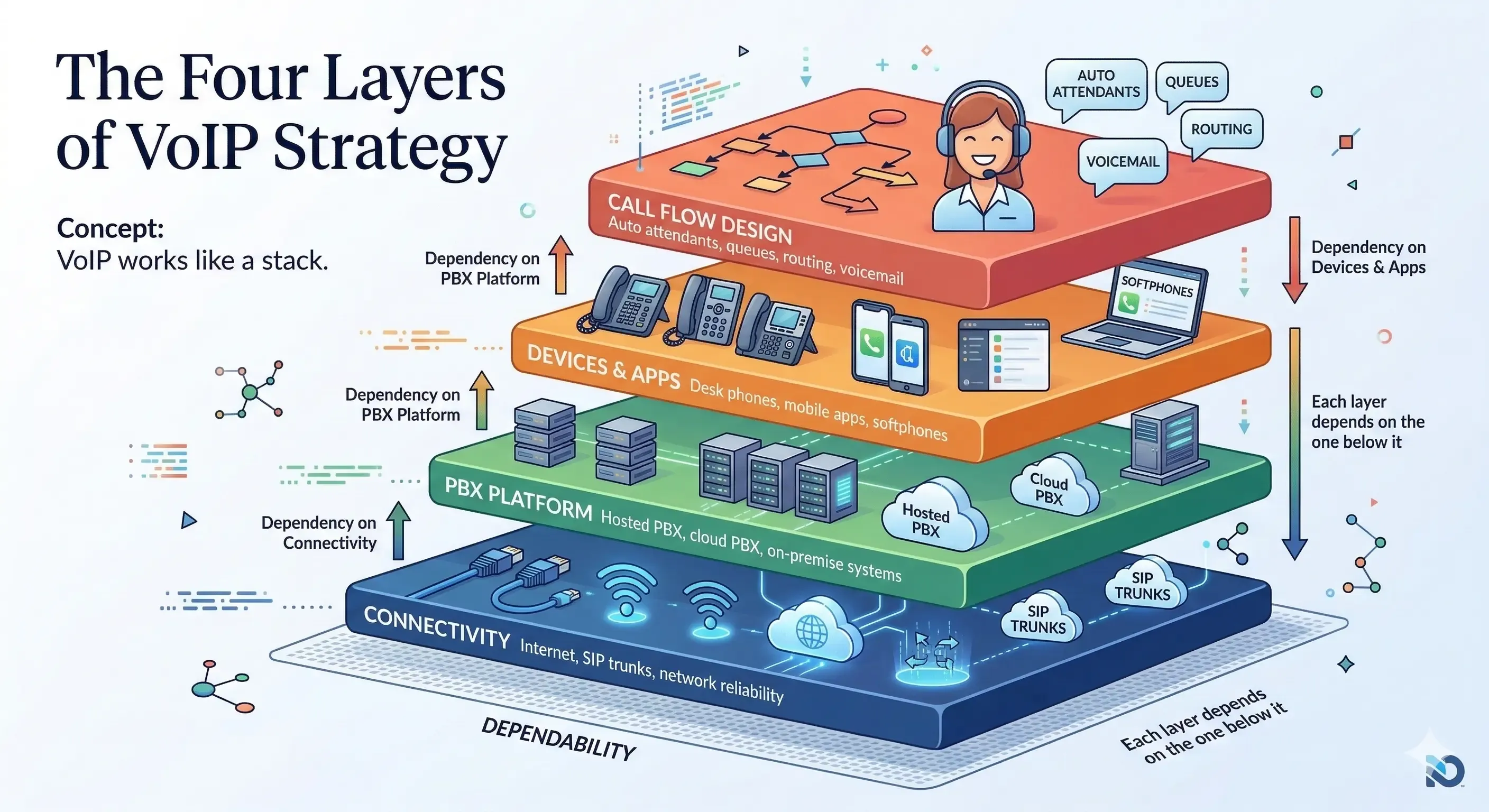
An effective VoIP deployment is constructed in four distinct layers, each requiring specific technical and strategic attention. These layers are Connectivity, Platform, Devices and Endpoints, and Call Flow and Business Logic. Neglecting any of these layers undermines the performance and reliability of the entire system.15
Connectivity
The connectivity layer is the foundation of the VoIP architecture. Because Voice over IP converts audio into digital data packets, the stability and quality of the internet connection determine the clarity of every conversation.13 A strong connectivity strategy must account for three primary metrics: latency, jitter, and packet loss.13
| Connectivity Metric | Industry Standard (Cisco/ITU) | Business Impact |
|---|---|---|
| Latency (One-Way Delay) | < 150 ms | Minimizes overlapping speech and conversational lag 13 |
| Network Jitter | < 30 ms | Prevents choppy or garbled audio 13 |
| Packet Loss | < 1% | Ensures words are not missing; > 3% renders calls unusable 13 |
Strategically, businesses must plan for bandwidth based on concurrent call volume. While a single call typically requires only 100 kbps, a 10-person office with five concurrent callers needs at least 500 kbps of dedicated, high-priority throughput.18 Advanced strategies employ Software-Defined Wide Area Networking (SD-WAN) to prioritize voice traffic (using DSCP 46 markings) and implement redundant internet connections to ensure that if one ISP fails, voice traffic automatically fails over to a secondary circuit.13
Platform
The platform is the centralized software that manages call routing, authentication, and signaling.15 Organizations must choose between hosted PBX platforms, cloud-based UCaaS providers, or on-premise VoIP servers.10 The platform determines the feature set, the ease of integration with other business tools, and the overall resilience of the system.9
When evaluating a platform, the vendor ecosystem is as important as the feature set. A platform that offers native integrations with CRM systems like Salesforce or collaboration tools like Microsoft Teams allows for the creation of automated workflows that boost productivity.6 Furthermore, the platform must support modern encryption standards like SIP over TLS and SRTP to ensure that communications remain secure from interception.22
Devices and Endpoints
Endpoints are the physical and virtual interfaces through which employees interact with the system. Many companies underestimate how much endpoint design affects usability.27 A comprehensive device strategy includes a mix of hardware and software based on employee roles.
| Device Type | Best Use Case | Key Strategic Value |
|---|---|---|
| VoIP Desk Phone | Receptionists, High-Volume Admins | Dedicated processing, tactile controls, line appearances 28 |
| Softphone (Desktop App) | Hybrid and Remote Knowledge Workers | CRM screen-pop, direct dial from computer, cost savings 27 |
| Mobile VoIP App | Field Sales, On-Call Staff | Mobile business identity, remote accessibility 28 |
| DECT Wireless Handset | Roving Healthcare or Retail Staff | Local mobility within a facility 28 |
Rather than a blanket policy, smart businesses deploy a blended model. For instance, an office might provide desk phones only to personnel whose primary job is call handling, while equipping the rest of the staff with high-quality headsets and softphone applications.28
Call Flow and Business Logic
This is the layer most companies ignore, yet it is where customer experience is won or lost. Call flow design includes the configuration of auto attendants, call queues, routing rules, and after-hours handling.32 A well-designed call flow ensures that a customer reaches the right department in the shortest time possible, reducing frustration and abandonment rates.32
Advanced call flow logic can include skill-based routing, which identifies a caller’s needs through IVR input and directs them to an agent with the specific expertise to solve the problem.25 Furthermore, “VIP Recognition” can use CRM data to identify high-value customers as soon as they call, fast-tracking them through queues directly to a dedicated account manager.6
Cloud vs On-Premise vs Hybrid VoIP
The selection of a deployment model is one of the most significant architectural choices a business must make. Each model—Cloud (Hosted), On-Premise, and Hybrid—solves different problems and carries unique financial and operational implications.10
Hosted and Cloud VoIP
Cloud telephony, or hosted VoIP, is a service where the phone system is managed by an external provider over the internet.12 This model is ideal for small to mid-sized businesses and distributed teams because it requires minimal on-site infrastructure and offers predictable monthly costs.10
The primary advantage of the cloud is scalability and resilience. Cloud providers operate multiple geo-redundant data centers; if one location fails, calls are automatically rerouted through another without user intervention.12 For a 50-person organization, a cloud system typically costs 40-60% less over five years compared to an on-premise deployment when factoring in the total cost of ownership (TCO).10
| Feature | Cloud (Hosted) VoIP | On-Premise PBX |
|---|---|---|
| Upfront Capital Spend | Low (£500–£2,000 for phones) | High (£15,000–£50,000 for hardware) 10 |
| Maintenance Responsibility | Service Provider | Internal IT or Contracted Support 11 |
| Scalability | Instant, pay-per-user | Limited by hardware capacity 10 |
| Disaster Recovery | Built-in geo-redundancy | Manual, site-specific failover 11 |
On-Premise VoIP
An on-premise PBX means the business owns or leases the hardware, servers, and wiring, all physically located at the office.12 While this model was the standard for decades, it is now primarily used by large organizations with strict control requirements, complex legacy integrations, or environments with unreliable internet connectivity.10
The benefits of on-premise systems include full control over data ownership and internal network reliability. However, they require significant upfront investment and ongoing expenditures for maintenance, electricity, and hardware expansion.23 Scaling an on-premise system can be slow, as adding users often requires the purchase of new cards, modules, or server capacity.11
Hybrid VoIP
Hybrid deployments combine the best of both worlds. A business might run its core call handling logic on-premise for office-based employees while routing external calls and remote users through a cloud-based trunking service.10 This model is often used as a transitional strategy for companies moving away from legacy ISDN lines toward a full-cloud environment.11
Hybrid systems offer flexibility and resilience, allowing a local PBX to handle internal calls if the internet goes down while maintaining a cloud failover path for external connectivity.9 However, they often introduce increased complexity that may not be justified for businesses without specialized requirements.10
Reliability and Redundancy Planning
A sophisticated VoIP strategy must plan for inevitable failures. Common risks include internet outages, carrier disruptions, and hardware failures.14 Reliability in modern telecommunications is not about preventing failure entirely—which is impossible—but about designing for rapid, automated recovery.1
Multi-Path Connectivity and SD-WAN
The most frequent point of failure in a VoIP system is the local internet connection. To mitigate this risk, businesses should implement redundant internet connections from different providers (e.g., a primary fiber line and a secondary cellular or cable link).14 SD-WAN technology can perform sub-second failover between these links, ensuring that an active call session does not drop even if one circuit fails.20
Provider-Level Redundancy
Leading VoIP providers maintain geo-distributed infrastructure across multiple data centers. If a regional outage affects a provider’s primary data center, traffic should automatically route to a secondary location.14 This “Active-Active” architecture ensures that the system is always operational, as backup nodes are constantly processing traffic rather than sitting idle waiting for a failure.38
Fallback Routing and Business Continuity
Failover mechanisms should be configured at the trunk and user levels. For example, if the primary office PBX is unreachable, the SIP trunk should be configured to automatically reroute calls to a secondary number, a mobile app, or a centralized voicemail system.14 This ensures that customers never receive a busy signal, even during a total facility outage.37
| Redundancy Level | Mechanism | Protection Benefit |
|---|---|---|
| Network | Dual ISP with SD-WAN | Protects against local fiber cuts and internet outages 14 |
| Provider | Geo-Distributed SIP Proxies | Protects against data center fires or regional blackouts 14 |
| Trunk | SIP Trunk Failover (Secondary Carrier) | Protects against primary telecom carrier disruptions 37 |
| Device | Mobile App Continuity | Allows staff to work from any location during a facility disaster 6 |
Security Considerations in VoIP
VoIP systems are internet-connected infrastructure, making them susceptible to cyber threats that traditional landlines never faced.2 Security planning must be built into the strategy from the outset, rather than being added as an afterthought.
Encryption of Signaling and Media
Unencrypted VoIP traffic is vulnerable to eavesdropping and data theft. A modern strategy must implement SIP over TLS (Transport Layer Security) to encrypt call setup signaling and SRTP (Secure Real-Time Transport Protocol) to encrypt the actual audio and video streams.17 These protocols ensure that even if data packets are intercepted, the content remains unreadable to attackers.17
Telecom Fraud Prevention
Telecom fraud, particularly International Revenue Share Fraud (IRSF), is a multibillion-dollar threat. Attackers hack into poorly secured PBX systems to make thousands of calls to high-cost international numbers, generating revenue for themselves while leaving the business with a massive bill.40
Prevention strategies include:
- Geo-Blocking: Disabling international dialing to high-risk countries where the business does not operate.42
- Strong Authentication: Enforcing complex passwords and multi-factor authentication (MFA) for all user accounts and administrative portals.3
- Traffic Monitoring: Implementing AI-driven monitoring that flags and blocks unusual spikes in call volume or after-hours activity.42
How VoIP Supports Hybrid and Remote Work
The modern workforce is increasingly distributed, and VoIP is the technology that makes location-independent communication possible.11 Unlike traditional systems that tether an employee to a physical desk, a VoIP extension follows the user.23
Remote Extensions and Mobile Apps
VoIP enables employees to use their business phone number on multiple devices simultaneously. A staff member can answer a call on their office desk phone, transfer it to their mobile app as they leave the building, and then continue the conversation on their home laptop softphone.27 This “one number, any device” approach maintains a professional image while providing ultimate flexibility.27
Shared Infrastructure Across Locations
For companies with multiple branches, VoIP creates a single, unified communication network. Employees can dial internal extensions across different cities as if they were in the same office.31 Furthermore, shared call queues allow teams in different time zones to support each other during peak periods, improving customer response times without increasing headcount.6 Surveys indicate that businesses using VoIP see a 62% increase in productivity for their remote and hybrid teams.46
Cost Strategy: Why VoIP Pricing Confuses Buyers
Many buyers struggle to compare VoIP quotes because pricing varies widely based on licensing models, hardware requirements, and telecom taxes.47 A strategic evaluation must look beyond the base monthly price to the total monthly cost and the long-term scalability of the solution.47
Licensing Models
- Per-User Licensing: The most common model, where businesses pay a flat monthly rate per extension. This is ideal for growing teams with dynamic sizes.47
- Metered Pricing: Lower base fees combined with per-minute charges. This works best for businesses with occasional phone use.47
- Unlimited Plans: A fixed fee that includes unlimited domestic calling, making it the most predictable option for high-volume call centers or sales teams.49
Telecom Taxes and Regulatory Fees
VoIP is taxed and regulated like a traditional telecom service in many jurisdictions. In the United States, several federal and state fees can significantly impact the final bill.51
| Regulatory Fee | Typical Purpose | Impact on Bill |
|---|---|---|
| Federal USF (Universal Service Fund) | Supports rural and underserved telecom access | Can exceed 30% of assessable revenue 52 |
| E911 Surcharges | Funds emergency dispatch infrastructure | $0.20 to $2.00 per line monthly 51 |
| Regulatory Recovery Fee | Offsets provider compliance and reporting costs | Varies by provider 51 |
| State/Local Telecom Taxes | Funds local infrastructure and programs | $1.00 to $10.00+ depending on state 51 |
Understanding these costs upfront prevents “sticker shock” when the first invoice arrives. Buyers should also evaluate one-time fees like number porting ($5–$15 per number) and hardware investment ($50–$300 per IP phone).47
Common VoIP Strategy Mistakes
Businesses often make the same tactical errors during their VoIP transition. Recognizing these pitfalls is the first step toward avoiding them.2
- Treating the Phone System as a Simple IT Purchase: Failure to treat VoIP as a strategic business tool leads to systems that are functionally correct but operationally inefficient. The system must be designed to support specific business goals like sales lead speed-to-lead or support first-call resolution.1
- Ignoring Call Flow Design: Many companies simply replicate their old, inefficient phone menus on the new system. This misses the opportunity to use advanced routing logic to improve the customer journey.32
- Choosing Vendors Based Only on Price: The cheapest quote rarely delivers the best value. Lower-priced plans often hide costs in per-minute fees, lack essential redundancy features, or offer poor technical support.10
- Failing to Plan for Redundancy: Assuming the internet will never go down is a recipe for disaster. Smart businesses always have a fallback plan, such as secondary ISP circuits or automatic call forwarding to mobile devices.2
- Inadequate Network Preparation: Implementing VoIP without prioritizing voice traffic on the local network results in poor call quality. Businesses must disable SIP ALG on routers and implement QoS rules to ensure voice packets are not delayed by other data.2
How to Design the Right VoIP Strategy
A structured design process transforms VoIP from a simple telecom decision into a significant operational improvement.44
Step 1: Map Current and Future Call Flows
Identify how calls currently flow through the organization and where bottlenecks occur. Are customers waiting too long? Are calls being transferred too many times? Mapping these interactions highlights areas where IVR logic or automated routing can provide immediate improvements.32
Step 2: Perform a Comprehensive Network Readiness Assessment
Run speed, jitter, and packet loss tests from the office network during peak hours.18 Ensure that the router and switches are “VoIP friendly” and can support Power over Ethernet (PoE) for desk phones.18
Step 3: Define Reliability and Security Requirements
Determine the acceptable amount of downtime for the business and design a redundancy plan to meet those objectives.14 Evaluate the security certifications of potential providers (e.g., SOC 2, HIPAA compliance) and ensure all communication paths will be encrypted.17
Step 4: Evaluate Integration and Automation Opportunities
Identify where the phone system can integrate with existing tools like CRMs, helpdesks, and collaboration platforms.58 Automation through tools like Zapier can eliminate manual data entry, such as automatically creating a support ticket from a missed call or logging call recordings directly into a customer’s CRM profile.58
Step 5: Design the User Experience and Train the Team
Focus on making the system intuitive for both customers and employees. Keep IVR menus short and clear, and provide training sessions to ensure staff know how to use advanced features like call parking, mobile app switching, and CRM screen-pops.19
The Future of VoIP Strategy
VoIP platforms continue to evolve beyond simple voice transmission, becoming integrated communication platforms that leverage data and artificial intelligence (AI).6
AI-Powered Conversation Intelligence
AI is now being used to provide real-time transcription and sentiment analysis.61 These tools can detect the emotional tone of a caller and alert a manager if a conversation is going poorly, allowing for immediate intervention.7 Additionally, AI receptionists can handle routine inquiries 24/7, booking appointments or answering basic support questions without human involvement.6
Deep Integration with the Business Stack
The phone system is becoming a data source for the entire business. Analytics on call data can reveal peak usage periods, identify which marketing campaigns drive the most high-value calls, and highlight common customer pain points.7 As VoIP technology matures, it will increasingly support 5G networks and the Internet of Things (IoT), allowing devices to “call” for support automatically when a fault is detected.6
Final Thoughts
A phone system should support how a business communicates, not force the business to adapt to the limitations of the technology. Companies that approach VoIP strategically gain significant advantages in customer experience, operational efficiency, and long-term cost control.1 The technology is mature; the real difference in performance comes from how it is designed and integrated into the broader business infrastructure.5 By following a structured design process and prioritizing connectivity, redundancy, and security, businesses can turn their phone system into a powerful tool for growth.1
Works cited
- Reactive vs Proactive Management: The Real Cost to Your Business In 2025 - Netguru, accessed March 7, 2026, https://www.netguru.com/blog/reactive-vs-proactive-management
- The Most Common Mistakes When Implementing VoIP in a Company - PLFON, accessed March 7, 2026, https://www.plfon.pl/en/blog/2025-01/most-common-mistakes-when-implementing-voip-company
- From Reactive To Proactive: Why Your IT Strategy Needs An Upgrade, accessed March 7, 2026, https://www.mspblueshift.com.au/insights/from-reactive-to-proactive-why-your-it-strategy-needs-an-upgrade/
- Understanding Reactive vs Proactive Managed Services - Power Consulting, accessed March 7, 2026, https://powerconsulting.com/blog/proactive-vs-reactive-managed-services/
- Proactive vs. Reactive IT Management: Which is Better? | Total BC, accessed March 7, 2026, https://www.totalbc.com/about/news/proactive-vs.-reactive-it-management-which-is-better-_ae53.html
- How Call Center VoIP Is Transforming Customer Support in 2025, accessed March 7, 2026, https://www.myaifrontdesk.com/blogs/how-call-center-voip-is-transforming-customer-support-in-2025
- The Role of Analytics in Making Smarter Business Decisions in the VoIP Industry - Telvoip, accessed March 7, 2026, https://www.telvoip.io/the-role-of-analytics-in-making-business-decisions/
- VoIP Statistics 2025: Real Numbers Behind the Revolution, accessed March 7, 2026, https://voiphunters.com/voip-and-statistics-what-the-numbers-really-say/
- 12 Awesome Examples of VoIP In 2024 - Unity Communications, accessed March 7, 2026, https://unity-connect.com/our-resources/tech-insights/voip-examples/
- Cloud vs. On-Premise vs. Hybrid PBX: 2026 Comparison | T2K …, accessed March 7, 2026, https://www.t2kvoip.co.uk/blog/cloud-pbx-vs-on-premise-vs-hybrid-phone-systems-which-type-is-right-for-your-business
- On-Premise vs Cloud Phone Systems: Which Is Right for Your Business? - The Unite Group, accessed March 7, 2026, https://theunitegroup.co.uk/2026/01/07/blog-on-premise-vs-cloud-phone-system/
- Comparing Cloud-Based vs. On-Premise Phone Systems in 2025, accessed March 7, 2026, https://www.phone.com/comparing-cloud-based-vs-on-premise-phone-systems-in-2025/
- What Is VoIP QoS & How Does It Improve Call Quality? - Nextiva, accessed March 7, 2026, https://www.nextiva.com/blog/voip-qos.html
- SIP Trunk Failover: How to Build a Redundant Voice System | IPComms, accessed March 7, 2026, https://www.ipcomms.net/blog/sip-trunk-failover/
- VoIP Network Diagrams for a Reliable Voice Architecture - 4PSA Blog, accessed March 7, 2026, https://blog.4psa.com/voip-network-diagrams-reliable-voice-architecture/
- Understanding VoIP Architecture - A Simple Explanation - VoIPstudio, accessed March 7, 2026, https://voipstudio.com/blog/understanding-voip-architecture-simple-explanation/
- 2025 Guide to VoIP Security Best Practices for Businesses - Velox Networks, accessed March 7, 2026, https://www.myvelox.com/blog/voip-security-best-practices-for-businesses
- How to Prepare Your Office Network for VoIP: A Step-by-Step Checklist, accessed March 7, 2026, https://www.vistanet.co/the-complete-voip-business-phone-system-setup-guide/how-to-prepare-your-office-network-for-voip/
- VoIP Deployment & Installation Checklist: 2026 UK Master Guide - Stride Communications, accessed March 7, 2026, https://stridecommunications.co.uk/voip-installation-checklist/
- How to Calculate Business Bandwidth Requirements | 2024 Guide - Oqitor, accessed March 7, 2026, https://www.oqitor.com/resources/bandwidth-requirements
- Network Performance Optimization with SD-WAN: QoS, Traffic Shaping, and Bandwidth Management, accessed March 7, 2026, https://niradnetworks.com/blog/network-performance-optimization-with-sd-wan-qos-traffic-shaping-and-bandwidth-management/
- SIP Protocol: Modernizing Business Calls With VoIP - Vonage, accessed March 7, 2026, https://www.vonage.com/resources/articles/sip-protocol/
- Types of VoIP Systems Explained: Hosted vs Cloud VoIP vs On Premises - VoIPCalling, accessed March 7, 2026, https://voipcalling.com/blog-post/types-of-voip-systems-explained-hosted-vs-cloud-voip-vs-on-premises/
- On-Premise vs Cloud: Choosing the Best IT Solution in 2025 - CAL IT Group, accessed March 7, 2026, https://calitgroup.com/on-premise-vs-cloud-2025/
- 15 Best AI Call Routing Software 2026 - CloudTalk, accessed March 7, 2026, https://www.cloudtalk.io/blog/best-call-routing-software/
- Ultimate Guide to VoIP Security Protocols 2025 - Tech Kooks, accessed March 7, 2026, https://techkooks.com/blogs/ultimate-guide-to-voip-security-protocols
- Softphone Explained For 2025: Benefits, Setup, And Business Gains - VitalPBX, accessed March 7, 2026, https://vitalpbx.com/blog/softphone-explained-for-2025-benefits-setup-and-business-gains/
- VoIP Desk Phone vs. Softphone vs. Mobile App: Which Setup Is Right for Each Role?, accessed March 7, 2026, https://www.vistanet.co/the-complete-voip-business-phone-system-setup-guide/voip-desk-phone-vs-softphone-vs-mobile-app/
- Softphone vs. VoIP: Everything You Need to Know in 2026 - CloudTalk, accessed March 7, 2026, https://www.cloudtalk.io/blog/softphone-vs-voip-phone-comparison/
- Softphone vs. Desk Phone: Finding the Right Mix for Your Workforce - Document Solutions, accessed March 7, 2026, https://www.dsbls.com/resources/softphone-vs-desk-phone-new-jersey/
- VoIP Phones vs Softphones vs Mobile Apps: Which Should You Choose? - WhichVoIP, accessed March 7, 2026, https://whichvoip.co.za/voip-phones/voip-phones-vs-softphones-vs-mobile-apps/
- What is a call flow? Best practices, types, and examples - Synergy Codes, accessed March 7, 2026, https://www.synergycodes.com/blog/what-is-call-flow-best-practices-types-and-examples
- Guide to designing an appropriate call flow - Megacall, accessed March 7, 2026, https://megacall.uk/guide-designing-call-flow/
- Call Flow Design: A Practical Guide for Businesses - Smith.ai, accessed March 7, 2026, https://smith.ai/blog/call-flow-design
- 5 Call Flow Designer Use Cases & Template Examples: From Simple to Advanced - Yeastar, accessed March 7, 2026, https://www.yeastar.com/blog/call-flow-designer-use-cases/
- How Businesses Use SIP Trunks for Disaster Recovery - DIDlogic, accessed March 7, 2026, https://didlogic.com/blog/sip-trunking-disaster-recovery/
- Ensuring Business Continuity with Redundant SIP Trunks: Why Choosing a Single Provider Makes Sense - SIPTRUNK, accessed March 7, 2026, https://www.siptrunk.com/blog/ensuring-business-continuity-with-redundant-sip-trunks-why-choosing-a-single-provider-makes-sense/
- 7 Proven Strategies to Implement VoIP High Availability Solutions Successfully - Ecosmob, accessed March 7, 2026, https://www.ecosmob.com/blog/voip-high-availability-solutions-implementation/
- SIP Trunking: Role in Disaster Recovery & Business Continuity Planning - LadiTech, accessed March 7, 2026, https://www.laditech.com/sip-trunking-key-role-in-disaster-recovery-and-business-continuity-planning/
- 12 Telecom Fraud Types You Should Know (and How to Stay Protected) | Voyced, accessed March 7, 2026, https://www.voyced.eu/12-telecom-fraud-types-you-should-know/
- Introduction to VoIP fraud | TransNexus, accessed March 7, 2026, https://transnexus.com/whitepapers/introduction-to-voip-fraud/
- How to Protect Your Business From VoIP Toll Fraud, IRSF, and AI-Driven Telecom Attacks, accessed March 7, 2026, https://kelleycreate.com/protect-business-from-voip-toll-fraud-irsf-and-ai-driven-telecom-attacks/
- Telecom Fraud Explained: Types, Risks, and Prevention Tips - Doppel, accessed March 7, 2026, https://www.doppel.com/blog/telecom-fraud-explained-types-risks-and-prevention-tips
- VoIP Phone System Installation | Business Setup Checklist, accessed March 7, 2026, https://www.businessbroadbandhub.co.uk/blog/voip-installation-checklist/
- VoIP Analytics: Leveraging Data for Enhanced Customer Experience - iCallify, accessed March 7, 2026, https://icallify.com/voip-analytics-leveraging-data-for-enhanced-customer-experience/
- 32 VoIP statistics for every business in 2026 | Zoom, accessed March 7, 2026, https://www.zoom.com/en/blog/voip-statistics/
- Cost of VoIP for Small Business: Complete 2025 Pricing Guide - The Network Installers, accessed March 7, 2026, https://thenetworkinstallers.com/blog/cost-of-voip-for-small-business/
- VoIP Cost in 2025: A Complete Breakdown to Help You Save Smarter - PerfectSoft.AI -, accessed March 7, 2026, http://perfectsoft.ai/voip-cost/
- Choosing the Right VoIP Plan for Your Business Needs - 3rd Element Consulting, accessed March 7, 2026, https://3rdelementconsulting.com/blog/choosing-right-business-voip-plan/
- How Much Does a Business VoIP Phone System Cost in 2025? - AIS Now, accessed March 7, 2026, https://www.ais-now.com/blog/voip-business-phone-system-cost
- Understanding VoIP Taxes & Fees in 2026 - Nextiva, accessed March 7, 2026, https://www.nextiva.com/blog/understanding-voip-taxes-and-fees.html
- Telecommunications Tax Compliance: Master 2025 Guide, accessed March 7, 2026, https://www.elitetaxstrategysolutions.com/telecommunications-tax-compliance/
- A Guide to U.S. Telecommunication Tax Compliance (2025) - SIP Trunk - ClearlyIP, accessed March 7, 2026, https://go.clearlyip.com/articles/pdfs/telecom-tax-compliance-us-2025.pdf
- A Guide to U.S. Telecommunication Tax Compliance (2025), accessed March 7, 2026, https://go.clearlyip.com/articles/telecom-tax-compliance-us-2025
- Excise Taxes and Fees on Wireless Services Up Again in 2025 - Tax Foundation, accessed March 7, 2026, https://taxfoundation.org/data/all/state/wireless-taxes-cell-phone-tax-rates-by-state-2025/
- Business VoIP Checklist: 16 Steps from Research to Deployment - OnSIP, accessed March 7, 2026, https://www.onsip.com/voip-resources/voip-fundamentals/business-voip-checklist-steps-from-research-to-deployment
- A 6-part checklist to setting up VoIP - ISG Technology, accessed March 7, 2026, https://www.isgtech.com/a-6-part-checklist-to-setting-up-voip/
- 10 Best Zapier Integrations for Business Automation in 2026 - CloudTalk, accessed March 7, 2026, https://www.cloudtalk.io/blog/best-zapier-integrations/
- Make Vs Zapier: Automation Tools Comparison (2025) | Ringover, accessed March 7, 2026, https://www.ringover.com/blog/make-vs-zapier
- Automate Missed Calls Handling Using Zapier - VoIPstudio, accessed March 7, 2026, https://voipstudio.com/blog/automate-missed-calls-handling-using-zapier/
- A Guide to Call Center Sentiment Analysis Best Practices - CloudTalk, accessed March 7, 2026, https://www.cloudtalk.io/blog/call-center-sentiment-analysis/
- Unlock Call Insights with AI Transcription & Sentiment Analysis - TeleCloud, accessed March 7, 2026, https://telecloud.net/blog/ai-transcription-sentiment-analysis-call-insights
- The ROI of Voice AI Agents: Real Business Results for Australian Companies in 2025, accessed March 7, 2026, https://tronic.com.au/roi-voice-ai-agents-australia-2025/
- Call Analytics for Call Centers: Boost Productivity - RingOffice, accessed March 7, 2026, https://ringoffice.com/blog/call-analytics
- 25 VoIP Statistics: What is the Future of Business Phone Systems? - nuacom, accessed March 7, 2026, https://nuacom.com/25-voip-statistics-what-is-the-future-of-business-phone-systems/
Building a predictable revenue model?
I help technology leaders design scalable sales systems and turn communications platforms into profitable recurring services.
Work With Greg
Greg Steinig
Telecom & MSP Revenue Strategist
Greg Steinig is Vice President of Sales at SPARK Services and a longtime leader in the telecommunications and managed services industries. He previously served as Vice President of Sales at 3CX, where he helped scale annual recurring revenue from $20 million to $167 million. Greg writes and advises on VoIP strategy, MSP growth, and revenue systems for technology companies.
Learn more about Greg →
.CTL8kw-5_10saEn.webp)